Wichita & Sedgwick County, KS
Hail Damage Roof Repair and Replacement in Wichita
The storm lasts ten minutes. The phone calls, door knocks and yard signs last for weeks.
Hail damage is harm to your roof from hailstones: bruised or cracked shingles, knocked-off granules, and dented vents, gutters and flashing. Hail damage roof repair fixes a few damaged spots. Replacement is for damage spread across the whole roof.
Below, you’ll see what hail damage looks like, what to do the day after a storm, when insurance pays, and what to do when your roofer and your adjuster disagree. Want a second set of eyes now? Read what a roof inspection should include.
What does hail damage look like on a roof?
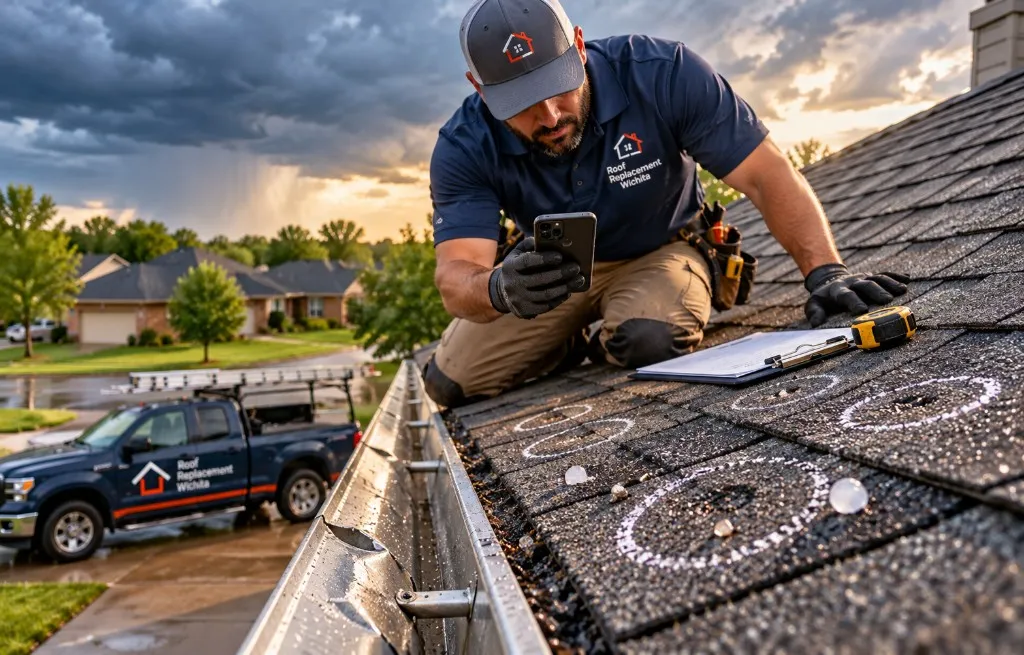
Hail damage on shingles looks like dark, round spots where granules got knocked off, soft bruises that feel spongy when pressed, and cracks that expose the black mat underneath. On metal, you’ll see round dents on vents, gutters, downspouts and flashing.
The hard part is telling hail from age. A common complaint in homeowner threads goes like this: “I don’t have the knowledge to tell aging shingles from hail damage.” Fair. Here’s the difference.
| What you see | Hail damage | Normal wear |
|---|---|---|
| Pattern | Random hits scattered across a slope | Even wear across the whole roof |
| Shape | Round marks, about the size of the hail | Irregular, no clear shape |
| Feel | Soft, bruised spots | Hard, brittle shingles |
| Granules | Missing in circles, with fresh black showing | Thinning everywhere, gradually |
| Metal | Fresh round dents on vents and gutters | Rust or oxidation, no dents |
| Where | Worse on the side facing the storm | Worse on the sunniest slopes |
Can you spot hail damage from the ground?
Yes, from the clues around your house. Stay off the roof.
Check these from the yard:
- Dents in gutters and downspouts
- Granules washed out at the bottom of downspouts
- Dents on the AC unit fins
- Spatter marks on painted fences or the deck
- Dents on your car, if it was parked outside
Two or more of those? Get an inspector on the roof.
What should you do right after a hailstorm in Wichita?
Right after a hailstorm, photograph the damage from the ground, tarp any leak, and get a roof inspection with dated photos before you call your insurer. Read your deductible first. Don’t sign anything with a roofer who knocks on your door the next morning.
Here’s the order that protects you:
- Stay safe. Don’t climb a wet roof.
- Take dated photos of gutters, downspouts, vents, the AC unit, siding and cars.
- Tarp any active leak the same day and save the receipt.
- Get an inspection with a written photo report. See what a roof inspection covers.
- Read your declarations page for the wind/hail deductible and whether you have RCV or ACV.
- Decide whether to file once you know the damage is bigger than your deductible.
- Report the claim within your policy’s deadline.
Hail season in Wichita runs from spring into summer. NOAA’s Storm Events Database logged 40 hail events in Sedgwick County in 2025, all between April and September (preliminary data).
Can a hail-damaged roof be repaired, or does it need replacing?
A hail-damaged roof can be repaired when the hits are limited to a few shingles or one slope, the roof is fairly young, and matching shingles are still made. When damage covers several slopes or the shingles are brittle, replacement is the fix.
Hail damage roof repair makes sense in fewer cases than people hope. Old shingles crack when a roofer lifts them to slide new ones in. And a patch that doesn’t match stands out from the street.
Repair tends to work when:
- Hits are on one slope, not all of them
- The roof is young enough that the shingles still bend without cracking
- The same shingle line is still sold
Replacement makes sense when:
- Bruises cover several slopes
- Granule loss exposes the mat in multiple spots
- Earlier repairs already patched the roof
For small, local damage, see roof repair in Wichita.
Will new shingles match the old ones?
Not always, and that’s a real worry for homeowners whose insurer approves only part of the roof. Colors fade and shingle lines get discontinued. Ask your insurer, in writing, how they handle matching before you accept a partial repair.
Should you file an insurance claim for hail damage?
File a hail damage claim when the inspection shows covered damage clearly bigger than your deductible. If repairs cost less than your deductible, filing gets you nothing. Ask your agent how a claim affects your rate before you file, not after.
That’s the question homeowners ask most after a roofer knocks: “Should I file or not?” A roofer at your door has a reason to say yes. You need the numbers first.
Here’s a quick way to decide:
- Get the inspection and a written repair or replacement price.
- Find your wind/hail deductible on your policy.
- Subtract the deductible from the price.
- Is the difference large? File. Is it small or negative? Pay for repairs yourself.
How does a percentage hail deductible work in Kansas?
Kansas policies commonly set wind and hail deductibles as a percentage of your home’s insured value, not a flat dollar amount. The math is simple and it surprises people:
| Home insured for | 1% deductible | 2% deductible |
|---|---|---|
| $200,000 | $2,000 | $4,000 |
| $300,000 | $3,000 | $6,000 |
| $400,000 | $4,000 | $8,000 |
And you pay it every time. People who’ve been through repeat storms report exactly that worry. One homeowner whose roof was replaced after hail in 2020 got hit again, with an estimated $50,000 replacement and an $8,000 deductible.
Free check
Is my damage bigger than my deductible?
Will insurance pay for hail damage to a roof?
Insurance pays for hail damage to a roof when your policy covers wind and hail, the damage came from the storm rather than age, and the loss beats your deductible. RCV vs. ACV coverage and any cosmetic exclusion decide how much.
Two policy terms set the size of the check:
- RCV (Replacement Cost Value): pays for a new roof at today’s prices, minus your deductible.
- ACV (Actual Cash Value): pays the depreciated value. On an older roof, that’s a lot less.
Then check for a cosmetic damage exclusion. With it, dents that don’t stop the roof from working aren’t covered. That hits metal roofs hardest.
Does insurance cover hail damage on an older roof?
Yes, if the damage is from hail and not from age. That’s where the fights start. In one homeowner thread, contractors expected a new roof on a 13-year-old roof, but the adjuster blamed the roof’s existing condition. The same adjuster still paid for hail damage to flashing, windows and even the mailbox.
Does insurance cover hail damage to gutters and siding?
Yes, separately from the roof. In homeowner threads, adjusters denied the roof but still covered hail damage to gutters, fascia, siding and windows. Make sure every damaged item is on the claim, not just the shingles.
What if the roofer says hail and the adjuster says no?
When the roofer says hail and the adjuster says no, ask the insurer for the denial reason in writing, send your roofer’s dated photos, and request a re-inspection. If you’re still stuck, get an independent inspection and check your policy for an appraisal clause.
Homeowner threads are full of this fight. One homeowner’s first roofer found hail on the roof, gutters, fascia and siding; a second roofer agreed on everything except the roof. In another thread, the insurer denied hail entirely, then found 32 wind-damaged shingles on a second inspection.
So who’s right? Here’s how to push back without guessing:
- Get the denial reason in writing.
- Send your inspector’s dated, close-up photos.
- Ask for a re-inspection, with your roofer on the roof at the same time.
- Get an independent inspection if the two sides still disagree.
- Read your policy’s appraisal clause, if it has one.
Why did the adjuster call it wear or wind?
Adjusters separate hail from age, and hail from wind, because policies treat them differently. Wear isn’t covered. Wind and hail are, but they can carry different deductibles. Ask the adjuster which cause they assigned to each damaged area, in writing.
How much does it cost to replace a roof from hail damage?
With an approved claim, a hail damage roof replacement costs you the deductible plus any ACV depreciation gap. Without insurance, you pay the full price: about $9,000 to $18,000 for a typical Wichita asphalt roof, based on published local pricing.
| Insurance claim approved | No claim / denied | |
|---|---|---|
| What you pay | Deductible + ACV gap (if any) | The full price |
| Example | 2% of a $300,000 home = $6,000 | About $9,000–$18,000 for typical asphalt |
| Upgrade to Class 4 | You pay the difference | Included in your price |
For roof-size math and a quote checklist, see roof replacement cost in Wichita. For what a full replacement includes, start with our roof replacement guide.
How do you spot a storm chaser after hail?
Storm chasers show up the morning after hail, knock on every door, push you to sign fast, and offer to “handle your insurance.” Before anyone climbs your roof, check their Kansas roofing registration and ask for a local office address.
People describe this scene in thread after thread: roofers “going around trying to get insurance money,” or a salesman who says your roof is “definitely going to leak” the day after hail. Not every knocker is a scammer. But the ones who vanish after the check clears knock too.
Red flags:
- “We just did your neighbor’s roof through insurance.”
- A contract they call “just an inspection form”
- Pressure to sign before the adjuster comes
- No local office, only a phone number
- Asking you to sign your claim over to them
Kansas has required roofers to register with the Attorney General since July 1, 2013. Look any company up in the Kansas AG Roofing Registration Directory before you sign.
Do Class 4 shingles stop hail damage?
Class 4 shingles resist hail better than standard shingles, but they don’t stop hail damage. Big hail still bruises and cracks them. Treat Class 4 as better odds and a possible insurance discount, not a hail proof roof.
Roofers in community threads push back hard on “hail proof.” They’re right. The rating means the shingle passed an impact test, not that it’s immune.
Replacing after a claim? Upgrading to Class 4 costs you the difference over what insurance pays for your current shingle. Compare lines in our guide to the best roof shingles for Wichita hail.
What else do people ask about hail damage?
People ask about the 25% rule, claim deadlines, whether filing raises premiums, whether a door-to-door roofer is safe to let on the roof, what a hail damage inspection costs, and whether hail causes leaks later. Short answers to each are below.
Hail Damage FAQs
What is the 25% rule in roofing?
The 25% rule limits how much of a roof you can repair before the whole roof has to meet current code. It’s best known from Florida. Whether it applies in Wichita is a question for MABCD, the local building department.
How long do you have to file a hail damage claim?
Your policy sets the deadline. Check your declarations page or ask your agent the same week as the storm. Waiting also makes it harder to prove which storm caused the damage.
Will filing a hail claim raise my insurance premium?
Ask your agent before you file. The answer depends on your insurer and your claim history. Kansas premiums rose about 15% on average in 2025, driven by area-wide storm losses: insurers paid $612 million on 56,778 storm claims in 2024, per ProgramBusiness reporting on Insurify data.
Is it safe to let a door-to-door roofer check my roof?
Only after you’ve checked their Kansas AG roofing registration and gotten a local office address. Don’t sign anything at the door.
How much does a hail damage inspection cost?
Wichita roofers such as Dingers Roofing and Equity Builders advertise free inspections with photos and a written report you can send to your insurer.
Can hail damage cause leaks later?
Yes. Bruised shingles lose granules and crack over time, so a roof that looks fine after the storm can leak months later. That’s why photos from right after the storm matter.